
 |
| Detail of photograph by Frank Hunter |
|
|
| Detail of photograph by Frank Hunter |
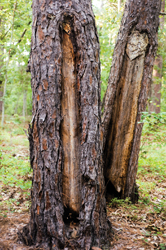 Weymouth was formerly named Shaw's Ridge after the immigrant family who worked the forest with their slaves as a tar and turpentine plantation. The "Bleeding Pines of Weymouth"
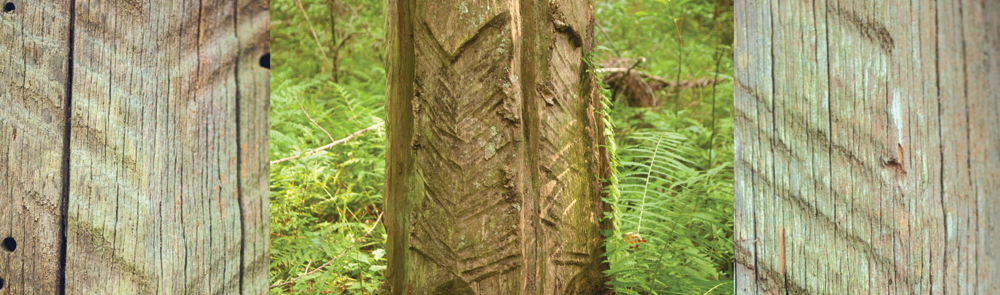
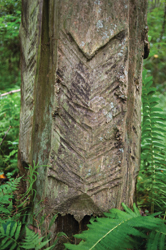
are longleaf pine trees (Pinus palustris) marked with V-shaped cuts made by former slaves or their descendants, to let loose the flow of sap collected for turpentine, pitch and rosin.
This viscous fluid bled down the trees into deep gashes, known as "boxes," that were carved into the base of the trunks. Hundreds of these trees remain in Weymouth Heights, composing an
undocumented, yet significant Scottish-American/African-American cultural landscape dating from the second half of the 19th century.
Weymouth was formerly named Shaw's Ridge after the immigrant family who worked the forest with their slaves as a tar and turpentine plantation. The "Bleeding Pines of Weymouth"
are longleaf pine trees (Pinus palustris) marked with V-shaped cuts made by former slaves or their descendants, to let loose the flow of sap collected for turpentine, pitch and rosin.
This viscous fluid bled down the trees into deep gashes, known as "boxes," that were carved into the base of the trunks. Hundreds of these trees remain in Weymouth Heights, composing an
undocumented, yet significant Scottish-American/African-American cultural landscape dating from the second half of the 19th century.
 Weymouth encompassed the region's last stand of original longleaf pine forest that once covered the
southeastern coastal plain. Boyd called upon his nephew, landscape architect Alfred Yeomans, to develop his Weymouth estate and incorporate the trees into his plan. Yeomans' layout featured
curving streets that wrapped around large wooded lots. As a result, many of the old-growth trees survive today scattered throughout the wooded Weymouth Heights section and in the adjacent
Weymouth Woods Sandhills Nature Preserve.
Weymouth encompassed the region's last stand of original longleaf pine forest that once covered the
southeastern coastal plain. Boyd called upon his nephew, landscape architect Alfred Yeomans, to develop his Weymouth estate and incorporate the trees into his plan. Yeomans' layout featured
curving streets that wrapped around large wooded lots. As a result, many of the old-growth trees survive today scattered throughout the wooded Weymouth Heights section and in the adjacent
Weymouth Woods Sandhills Nature Preserve.